Collaboration: unlocking teamwork for better outcomes
A practical guide to understanding collaboration, why it matters, and how to do it well across teams and projects.
Collaboration is more than working together. It’s a deliberate approach to pooling expertise, sharing accountability, and creating outcomes that surpass what individuals can achieve alone. In today’s complex work environments, collaboration is not optional, it’s essential. This article explores what collaboration means, why it matters, and practical steps to improve it in teams, across departments, and with external partners.

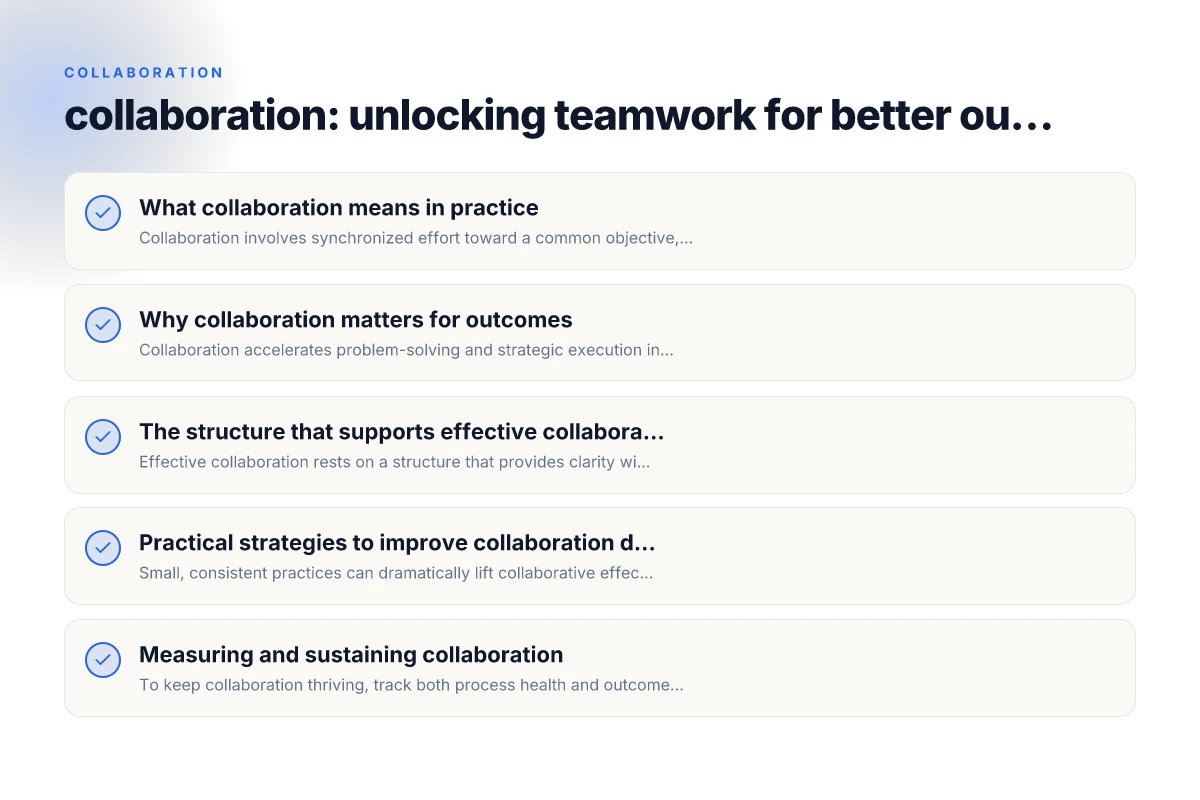
What collaboration means in practice
Collaboration involves synchronized effort toward a common objective, facilitated by trust, open communication, and a shared sense of purpose. It’s not about enforcing sameness, but about balancing diverse perspectives to arrive at better decisions and higher-quality results. Key elements include:
- Shared goals: A clear, agreed-upon outcome everyone can rally around.
- Complementary strengths: Different skills, experiences, and viewpoints that fill gaps.
- Mutual accountability: Each member feels responsible for the team’s success or failure.
- Open information flow: Access to relevant data, feedback, and insights.
When collaboration is aligned with these elements, teams move faster, innovate more, and deliver solutions that customers and stakeholders value.
Why collaboration matters for outcomes
Collaboration accelerates problem-solving and strategic execution in several ways:
- Faster ideation and iteration: Diverse ideas spark creativity, and rapid feedback loops shorten cycles.
- Higher quality decisions: Collective intelligence reduces blind spots and spreads risk.
- Better cross-functional alignment: Shared understanding prevents silos and conflicting priorities.
- Increased engagement and retention: People feel included and valued when they contribute meaningfully.
- More resilient execution: Teams can adapt to changes when knowledge is distributed and accessible.
Organizations that invest in collaborative practices often see improvements in project speed, employee satisfaction, and customer satisfaction. The payoff isn’t just soft culture, it translates into measurable performance gains. Totalav vs norton antivirus: which one gives you better protection
The structure that supports effective collaboration
Effective collaboration rests on a structure that provides clarity without stifling autonomy. Consider these pillars:
Clear goals and success criteria
Define the objective in concrete terms (what, by when, and how we’ll know it’s done).
Establish measurable success criteria early. Total av review what other sites wont tell you about this complete antivirus
Defined roles and responsibilities
Use RACI-like framing (Responsible, Accountable, Consulted, Informed) to reduce confusion.
Assign owners for key tasks, with explicit decision rights.
Transparent processes and rituals Norton antivirus review 2019 is norton the best antivirus
Agree on how decisions are made, how conflicts are resolved, and how information is shared.
Establish regular cadences (standups, planning sessions, reviews) that suit the team’s tempo.
Communication norms
Decide on primary channels, response-time expectations, and meeting etiquette. Mcafee vs norton which antivirus is best in
Encourage proactive sharing of updates, risks, and blockers.
Shared tools and access
Use collaborative platforms that enable real-time collaboration, version control, and audit trails.
Ensure data and documents are accessible to all relevant participants. How good is norton 360 exactly our expert review for
Psychological safety
Foster an environment where teammates can speak up, challenge ideas, and admit mistakes without fear.
Normalize constructive disagreement as a path to better outcomes.
Practical strategies to improve collaboration day-to-day
Small, consistent practices can dramatically lift collaborative effectiveness. Here are concrete strategies you can start applying this week: Bitdefender antivirus review: is bitdefender a good antivirus
Align early, iterate often
Begin projects with a collaboration kickoff to align on goals, scope, and roles.
Schedule short, frequent check-ins to surface issues early.
Normalize feedback loops 4 Best things about fiverr that you probably dont know a full fiverr review
Build structured feedback moments into milestones.
Use a mix of peer review, user feedback, and data-driven insights.
Establish a collaboration-friendly culture
Recognize and reward collaborative behavior, not just individual achievement. 99 Designs review get your logo designed by experts
Provide learning opportunities (workshops, cross-team shadowing, documentation).
Use lightweight, purposeful meetings
Invite only essential participants. Share an agenda and desired outcomes in advance.
End meetings with clear next steps and owners. A full office 365 review for families businesses and single households
Create a single source of truth
Maintain a centralized repository for project plans, decisions, and learnings.
Keep version history and rationale for decisions visible and easy to audit.
Resolve conflicts constructively G suite review is g suite better than office
Encourage structured debate, with a decision-making framework (e.g., decision registers).
When disagreements stall progress, escalate to a neutral facilitator or a decision-maker.
Tools that can help collaboration
A well-chosen toolkit reduces friction and boosts information flow. Consider the following categories and examples:
- Project management
- Asana, Trello, Jira
- Documentation and knowledge sharing
- Notion, Confluence, Google Docs
- Communication
- Slack, Microsoft Teams, Discord
- File sharing and version control
- Google Drive, OneDrive, GitHub (for code and docs)
- Visual collaboration
- Miro, Figma, Lucidchart
Table: quick comparison of collaboration tools in common scenarios Hootsuite review everything other sites wont tell you about hootsuite
| Category | Popular options | Strengths | Ideal use case |
|---|---|---|---|
| Project management | Jira, Asana | Task tracking, workflows, reporting | Software projects, cross-team programs |
| Documentation | Notion, Confluence | Rich pages, linking, search | Centralized knowledge base, playbooks |
| Communication | Slack, Teams | Real-time chat, channels, threads | Rapid coordination, quick blockers |
| File sharing | Google Drive, OneDrive | Real-time co-editing, permissions | Shared documents, living docs |
| Design/brainstorming | Miro, Figma | Visual collaboration, boards | Brainstorming sessions, UX design |
Measuring and sustaining collaboration
To keep collaboration thriving, track both process health and outcome impact. Helpful metrics include:
- Process health: frequency of updates, clarity of roles, time to decision, meeting-to-output ratio.
- Psychological safety indicators: willingness to admit mistakes, openness to feedback, and perceived support.
- Outcome impact: alignment with goals, quality of deliverables, customer or stakeholder satisfaction, time-to-market improvements.
Regular reflection is essential. Try quarterly retrospectives focused not just on results, but on collaboration dynamics: What helped? What hindered? What should we change?
Invest in onboarding practices for new team members that emphasize collaboration norms. A short onboarding guide that includes decision rights, preferred channels, and example collaboration scenarios can speed integration and maintain consistency.
Common collaboration pitfalls and how to avoid them
Even strong teams can stumble. Awareness is the first defense. Common pitfalls include: Our complete guide to slack
Siloed work and information hoarding
Fix: publish decisions and sources of truth. Rotate coordination roles.
Over-communication or meeting fatigue
Fix: enforce strict agendas, use asynchronous updates, and limit meetings to necessary participants.
Ambiguity about who owns what
Fix: document roles and responsibilities upfront. Revisit them when scopes change.
Resistance to conflict
Fix: train teams in constructive disagreement and decision-making processes.
Tool overload
Fix: simplify by selecting a core set of tools that cover essential needs and integrate them where possible.
A short guide to starting a collaboration-first project
If you’re starting a new project and want to embed collaboration from the ground up, here’s a practical starter plan:
- Define the shared objective
- Write a one-paragraph statement that captures the goal, success criteria, and impact.
- Assemble the core team with clear roles
- Identify the primary owner, contributors, and stakeholders. Define decision rights.
- Choose a minimal toolset
- Pick one primary project management tool, one documentation platform, and one communication channel.
- Establish a collaboration charter
- Create a short document outlining norms, meeting cadence, communication expectations, and how decisions are made.
- Run a kickoff and set the first milestone
- Align on scope, risks, dependencies, and the first deliverable with a tangible deadline.
- Build feedback into the rhythm
- Schedule regular retrospectives and stakeholder reviews to stay aligned and adapt.
- Measure and adjust
- Track the health metrics you set and iterate on processes as needed.
The recommendation: embrace collaboration as a strategic capability
Collaboration is not a one-off tactic. It’s a strategic capability that compounds over time. When teams consistently align goals, clarify roles, and invest in open communication and mutual accountability, they unlock higher quality outcomes, faster delivery, and more resilient operations. Start with the essentials: a clear objective, defined roles, and a lightweight, shared set of tools. Then institutionalize routines that preserve psychological safety and continuous learning.
If you want to maximize collaboration across your organization, begin with a lightweight pilot in one cross-functional project. Measure both process health and outcomes, then scale lessons learned to other teams. Over time, a collaboration-first culture becomes a competitive advantage, enabling faster iteration, better decisions, and a more engaged workforce.